Looking for a Gumloop alternative? Here are the 10 best AI automation and agent-building platforms to consider in 2026, ranked and reviewed.


Looking for an alternative to Gumloop?
If you're reading this article, you're excited about how you can use AI in your business to save time and augment the work you can do on your own.
AI automation and agent-building tools have gone from experimental to essential. In 2026, the market has moved well beyond simple trigger-action workflows — we're in the era of full-blown agentic systems where AI can reason, plan, and execute multi-step tasks across your entire tech stack.
Gumloop is one of the hottest players in this space. The platform just closed a $50M Series B led by Benchmark (with participation from Shopify Ventures, First Round Capital, Y Combinator, Nexus Venture Partners, and others), bringing total funding to $70M. Gumloop lets teams build AI agents and automations using a visual, no-code workflow designer — and it's used by companies like Shopify, Ramp, Gusto, Samsara, Instacart, and Opendoor.
But if you're looking for alternatives, you've likely run into one of these friction points:
The learning curve is steeper than expected, especially for non-technical team members.
It's missing key integrations you need for your specific workflows.
The credit-based pricing gets expensive fast — particularly with AI-heavy workflows.
You want more human-in-the-loop controls to review what your AI agents are doing before actions are taken.
Whether you're after a simpler interface, broader integrations, better governance features, or a more predictable pricing model, you've come to the right place.
TL;DR
First, if you only have 30 seconds, here's what you need to know:
If you're looking for the best all-around alternative with an easy-to-use agent builder and human-in-the-loop controls, start with Relay.app.
If you need the largest integration library on the market (8,000+ apps), Zapier is hard to beat.
If you're a technical power user who wants granular control over complex, visual workflows, Make or n8n are excellent picks.
If you're in a regulated enterprise needing SOC 2, HIPAA, and on-prem deployment, check out Stack AI.
If you want purpose-built AI agents for sales and GTM, Relevance AI is worth a look.
Now, if you have a bit more time, read on to learn more about Gumloop, what you should consider in an alternative — then we'll dive into the full list of 10 options.
What is Gumloop?
Gumloop is a no-code AI automation and agent platform designed to help teams build, deploy, and manage AI agents without writing code. Founded in mid-2023 and backed by Y Combinator, Gumloop raised a $50M Series B led by Benchmark in March 2026 — bringing total funding to $70M and cementing its place as a serious force in the AI-native automation market.
The platform uses a visual, node-based workflow builder where you drag and drop triggers, logic steps, integrations, and AI actions onto a canvas. What sets Gumloop apart from traditional automation tools is that every node can contain AI logic — you can analyze text, make decisions, and transform data within a workflow without wiring external API calls. Gumloop is also model-agnostic, letting you pick the best AI model for each task (OpenAI, Anthropic, Gemini, DeepSeek, and more) under a single subscription with no per-model fees.
Gumloop has evolved well beyond simple workflow automation. The platform now includes:
Gumloop Agents — proactive AI agents that anyone at a company can build and deploy natively across Slack, Teams, and email
Gummie — a meta-agent that generates workflows from natural language descriptions
Gumstack — a dedicated security platform for monitoring and controlling data use across your organization's AI tools (including ChatGPT, Claude, and Cursor)
Skills — custom plug-ins that extend an agent's capabilities for specific tasks like ticket severity ranking, SQL queries, and more
It's trusted by teams at Shopify, Ramp, Gusto, Samsara, Instacart, and Opendoor, and is compliant with SOC 2 Type II and GDPR.
Key features of Gumloop
Here's a quick look at where Gumloop shines:
Visual, node-based workflow builder with 115+ pre-built blocks for drag-and-drop automation
AI-native nodes for text generation, data extraction, summarization, classification, and intelligent routing
Model-agnostic architecture — support for multiple AI providers within the same workflow, no per-model fees
Built-in AI credits so you don't need to bring your own API keys on the free tier
Parallel execution of sub-workflows for faster processing
Gumloop Agents that deploy natively to Slack, Teams, and email
Gumstack for enterprise-grade security monitoring and AI data governance across your org
Chrome extension for browser-based data capture and automation
Skills system for extending agents with custom plug-ins and capabilities
Now that you know what Gumloop brings to the table, let's look at what you should prioritize when evaluating an alternative.
What to look for in a Gumloop alternative
If you're seeking a Gumloop alternative, you may already have a specific frustration in mind. Perhaps you need an easier-to-use experience, better governance controls, or a more predictable pricing model. But if you're new to the market, here's what we think you should consider — and what we used as criteria for the tools we reviewed:
Ease of use: You shouldn't need a technical background to build powerful AI-driven workflows. The best tools in 2026 let you describe what you want in plain language and get started in minutes.
AI capabilities: Table-stakes AI features now include agentic workflows, multi-model support, MCP (Model Context Protocol) compatibility, and multi-step reasoning — not just simple prompt-and-response actions.
Human-in-the-loop controls: As AI agents take on more autonomous tasks, the ability to review, approve, or reject actions before they execute is critical. Governance and oversight aren't optional anymore — they're a must-have.
Integrations: Seamless connections to your existing tools and platforms. The broader the connector library, the less time you spend on workarounds.
Security & compliance: With enterprise adoption accelerating, certifications like SOC 2, HIPAA, and GDPR — plus features like audit trails, RBAC, and data residency controls — matter more than ever.
Scalability: The platform should grow with your team. You shouldn't need to migrate to a new tool in six months because you've outgrown the free plan or hit a ceiling on concurrent executions.
Pricing transparency: Credit-based and usage-based models can get expensive fast, especially with AI-heavy workflows. Look for clear, predictable pricing that won't surprise you at the end of the month.
Not every tool will check all the boxes, but these criteria provide a solid framework for evaluating your options.
Now, without further ado, let's dive into the list of the best Gumloop alternatives.
The 10 best Gumloop alternatives in 2026
1.
Relay.app
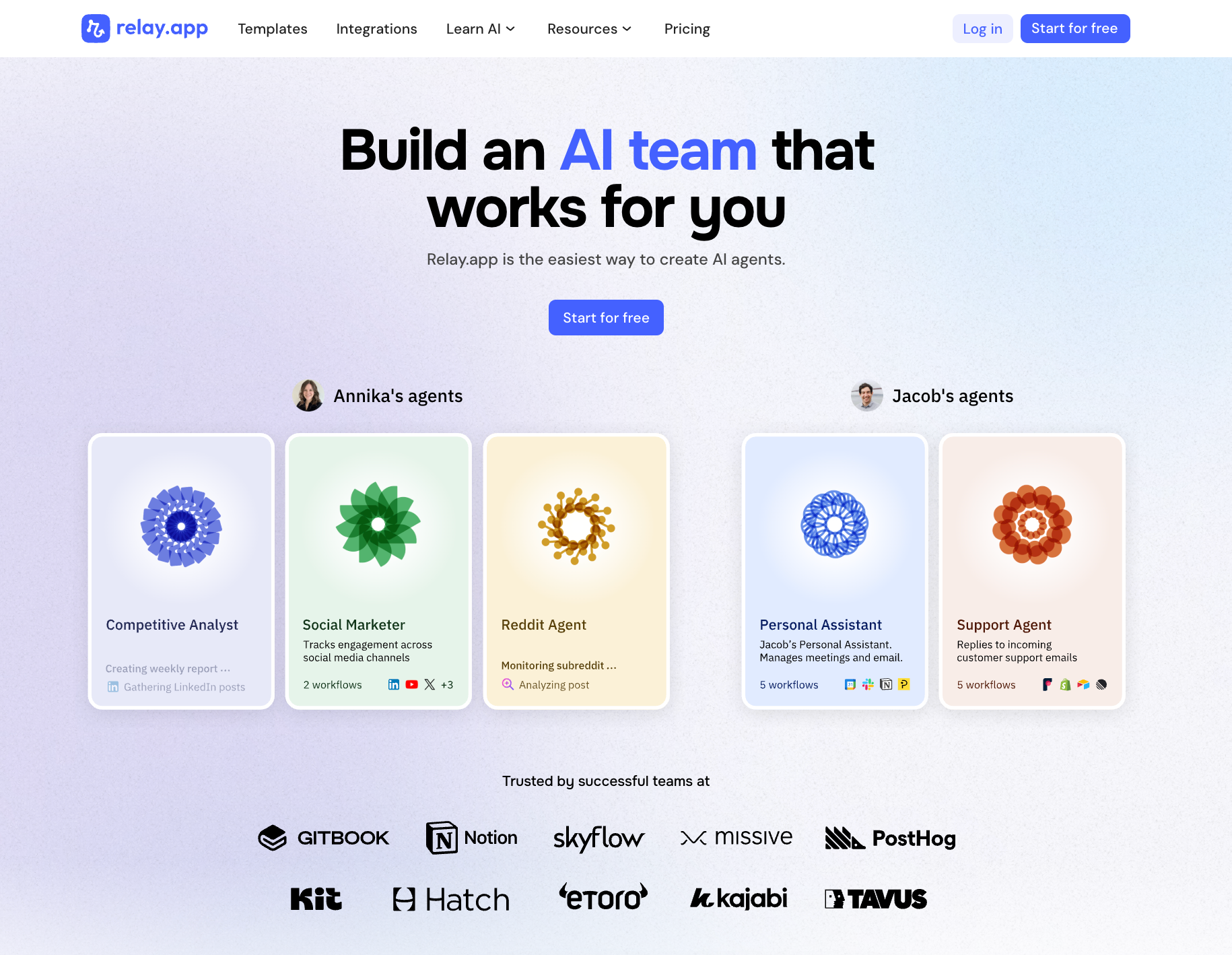
Relay.app stands out because it is incredibly easy to use. Non-technical users who have struggled with tools like Zapier and Make.com can create AI workflows in minutes. To create predictable, reliable AI workflows in Relay.app, all you need to do is explain what you want in plain language, and the Relay.app Agent will do it for you, from creation to editing to improving and analyzing results.
Product details
Ease of use: Relay.app is well liked for its ease of use for users and teams of all abilities, both non-technical and technical alike.
Natural language workflow creation: You can chat with the Relay.app Agent in natural language to create AI workflows, as well as edit them, improve them, and analyze results.
Technical flexibility: Relay.app also supports more technical and custom use cases with custom code, complex branching/looping logic, webhooks, and custom HTTP calls.
Simple visual representation: AI workflows have a clear visual layout that shows you exactly what will happen when they run.
Human-in-the-loop: Options let people review or approve actions. This lets you keep an eye on what the AI is coming up with!
Built-in AI models: All the best AI models are included (OpenAI, Anthropic, Gemini, and more) and run using Relay.app's AI credits. You don't need API keys to use them (but you can use your own if you like!).
200+ native integrations: Deep native integrations with popular tools so you can automate work and move data between all the apps you and your team use. (If there's an integration Relay.app doesn't have yet, you can also use custom HTTP requests to connect your tools.)
You can read more here about how Relay.app works.
Pricing
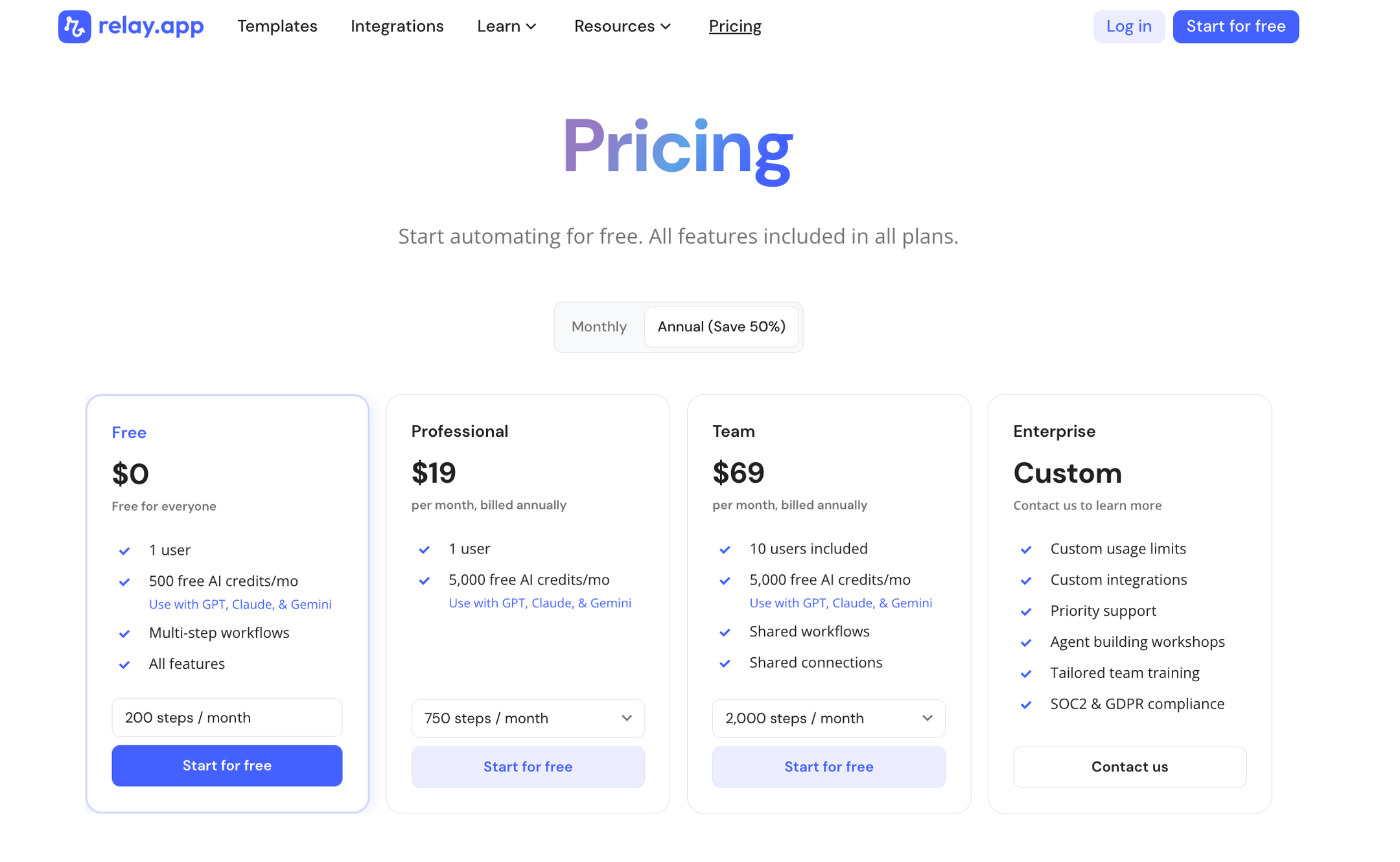
Relay.app has free and paid plans. On paid plans, you can purchase additional steps and AI credits as needed. All plans include free test runs so you can validate your workflows really work before you publish them!
Free tier: Yes. Includes 1 user, 200 automation steps, and 500 AI credits per month.
Professional: For 1 user, $19/month when billed annually. Includes 750 steps and 2,000 AI credits per month.
Team: For up to 10 users, $69/month when billed annually. Includes 2,000 steps and 2,000 AI credits per month.
Enterprise: Custom pricing for organizations with heavy usage or custom requirements.
2.
Zapier
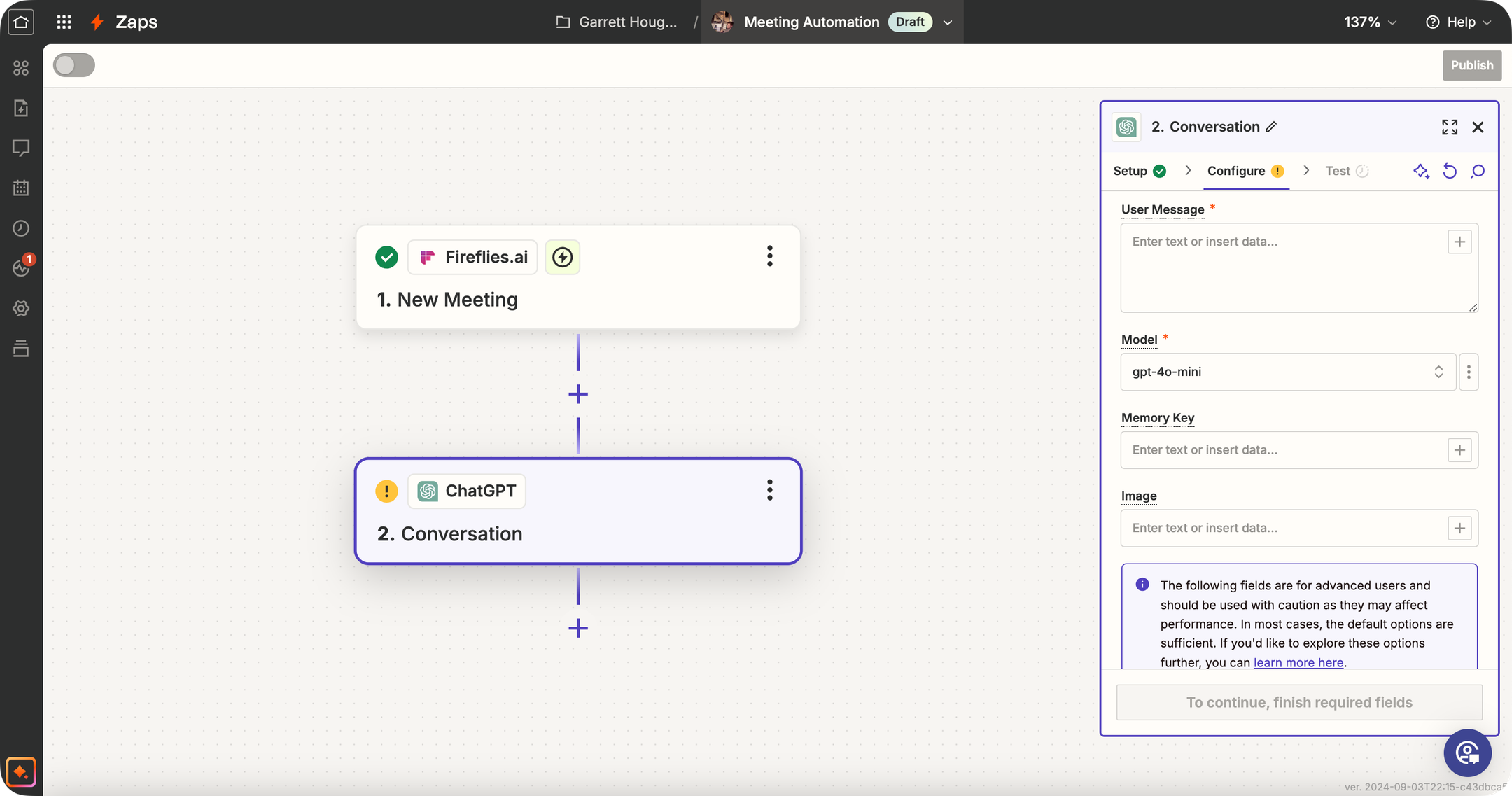
Zapier is a one of the best-known automation tools (the "OG" of no-code workflows) that has significantly expanded its AI capabilities. Traditionally, Zapier connects your apps: "When X happens in app A, do Y in app B." Now, Zapier offers dedicated AI Agents, AI Chatbots, Canvas, and MCP. Zapier isn't an AI-specialized platform like some others here, but its strength is the 8,000+ app integrations it supports. This means you can trigger AI agents based on almost any event (new email, form submission, CRM update, you name it) and then have the AI perform an action or generate content as part of the Zap.
Product details
Massive integration ecosystem: Zapier connects with over 8,000 apps, so your AI agent can interact with nearly any tool your business uses. This is unmatched in the industry.
Mature product and platform: Zapier has a reputation for dependable execution of workflows, extensive documentation, and a lot of community support.
Extensive template library: Thousands of pre-built Zap templates (including many with AI) can help get you started quickly.
Expanding AI toolkit: Zapier now offers dedicated AI Agents, Chatbots, Canvas, and MCP support alongside its core automation platform.
The OG of no-code workflows: Being a long-time champion of the space means that they have many years of added features, but this also means it's more difficult to evolve significantly.
Pricing
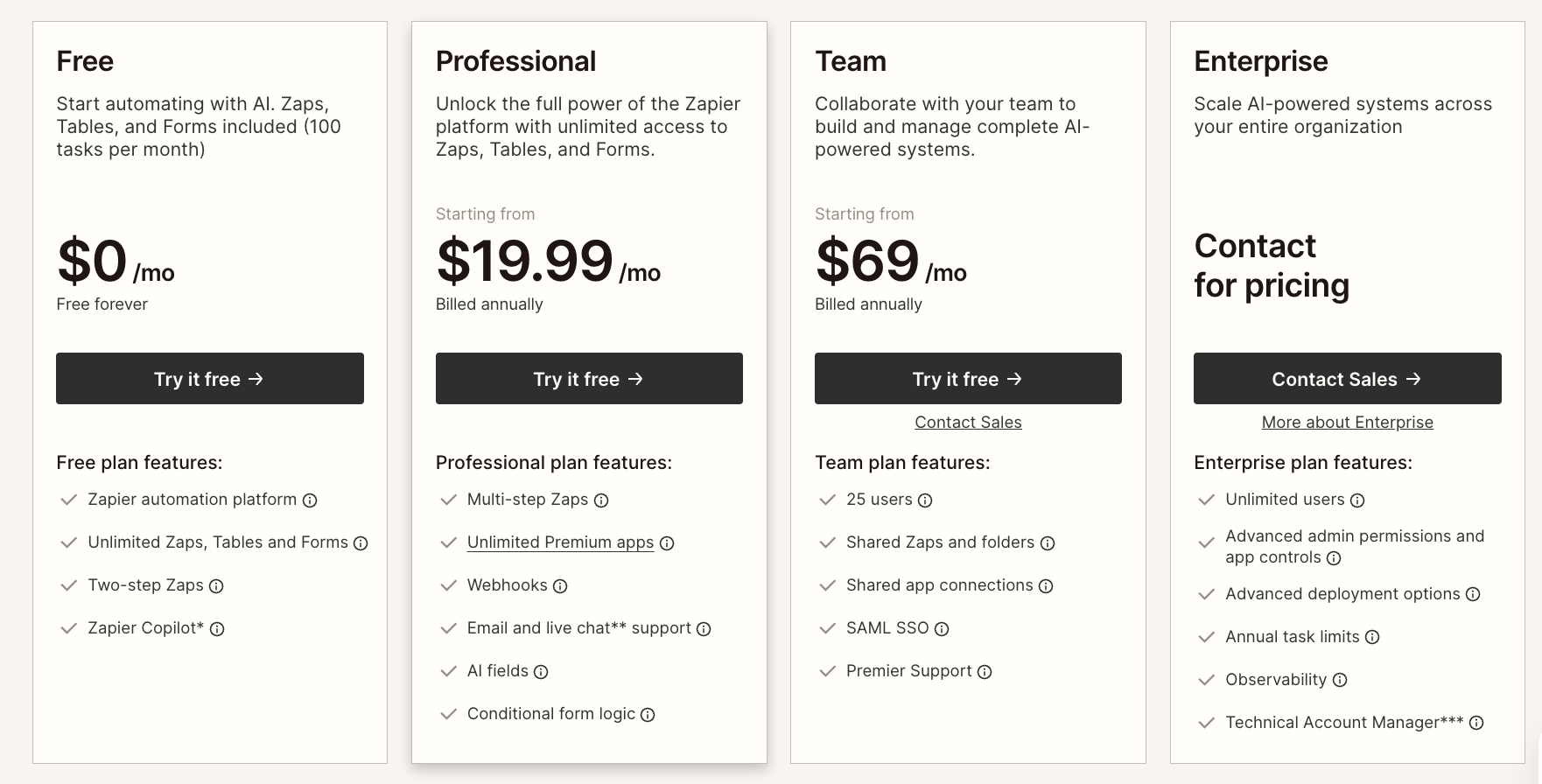
Free Tier: Yes – 100 tasks/month with two-step Zaps, plus Tables, Forms, and Zapier MCP included.
Professional: Starting from $19.99/month (billed annually) – multi-step Zaps, unlimited premium apps, Tables, Forms, and MCP included.
Team: Starting from $69/month (billed annually) – 25 users, shared Zaps, SAML SSO.
Enterprise: Custom pricing – unlimited users, advanced admin controls, observability.
AI Agents add-on: Free (400 activities/mo) or Pro ($33.33/mo for 1,500 activities).
Chatbots add-on: Free (2 chatbots), Pro ($13.33/mo for 5 chatbots), or Advanced ($66.67/mo for 20 chatbots).
3.
Make
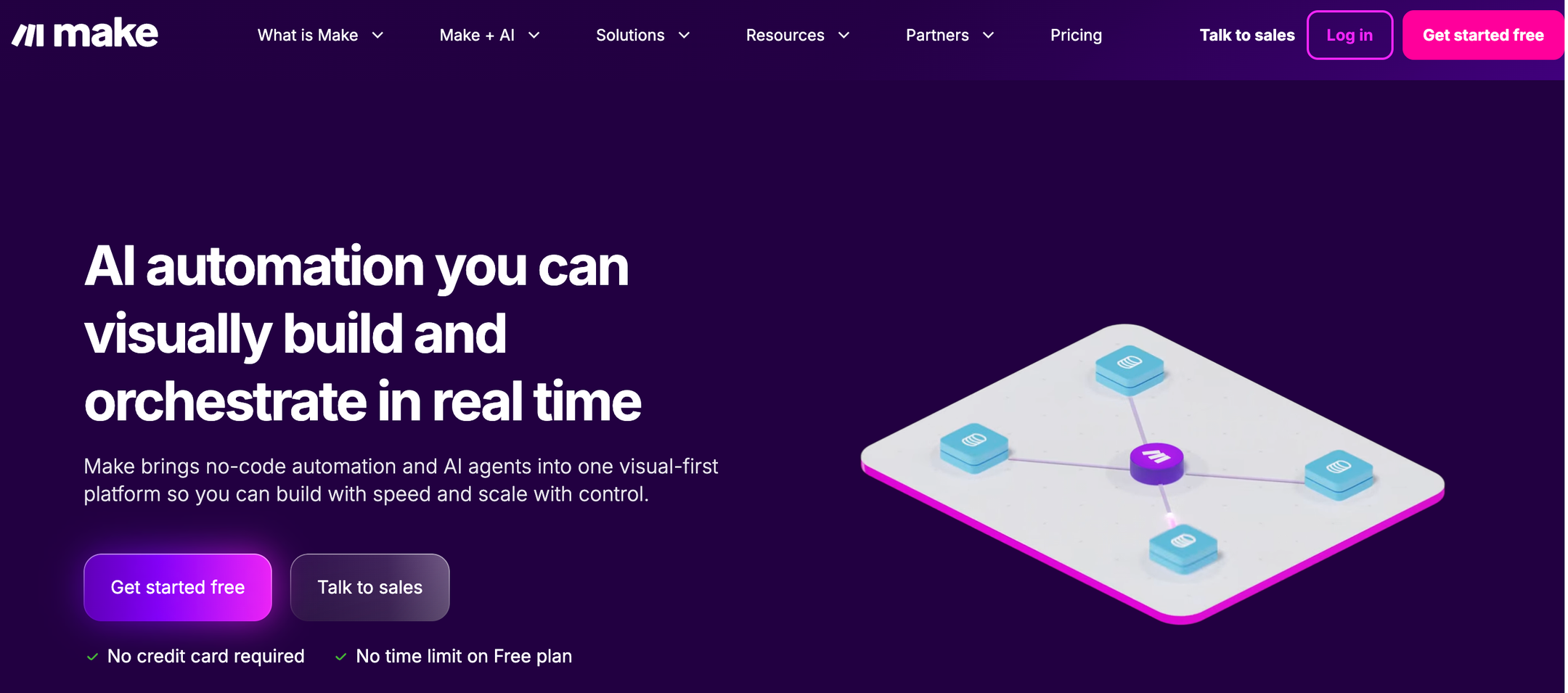
Make is a visual-first no-code automation platform that lets you design complex workflows on a canvas by connecting modules from 3,000+ apps. It supports advanced logic like branching, filtering, iteration, and error handling, making it popular with power users who need more control than simpler tools offer. Make has recently expanded into AI with beta AI Agents, an AI Toolkit, MCP server support, and 400+ AI app integrations including OpenAI, DeepSeek, and Perplexity. Make is well-suited for technical users and teams that need to build sophisticated, multi-step automations with granular control over every step.
Product details
It's a powerful visual scenario builder: The canvas-based editor lets you see exactly how data flows through your automation. Great for debugging and complex logic.
Advanced workflow logic: Supports branching, filtering, iteration, and error handling that most simpler tools can't match.
Strong integration library: Connects with 3,000+ apps, with deep action support across most of them.
Generous pricing relative to complexity: Make offers more operations per dollar than Zapier, making it attractive for higher-volume automations.
Steep learning curve: Make's power comes at a cost. Non-technical users typically need 10–20 hours before feeling comfortable, and concepts like routers, iterators, and aggregators take real investment to learn.
Pricing
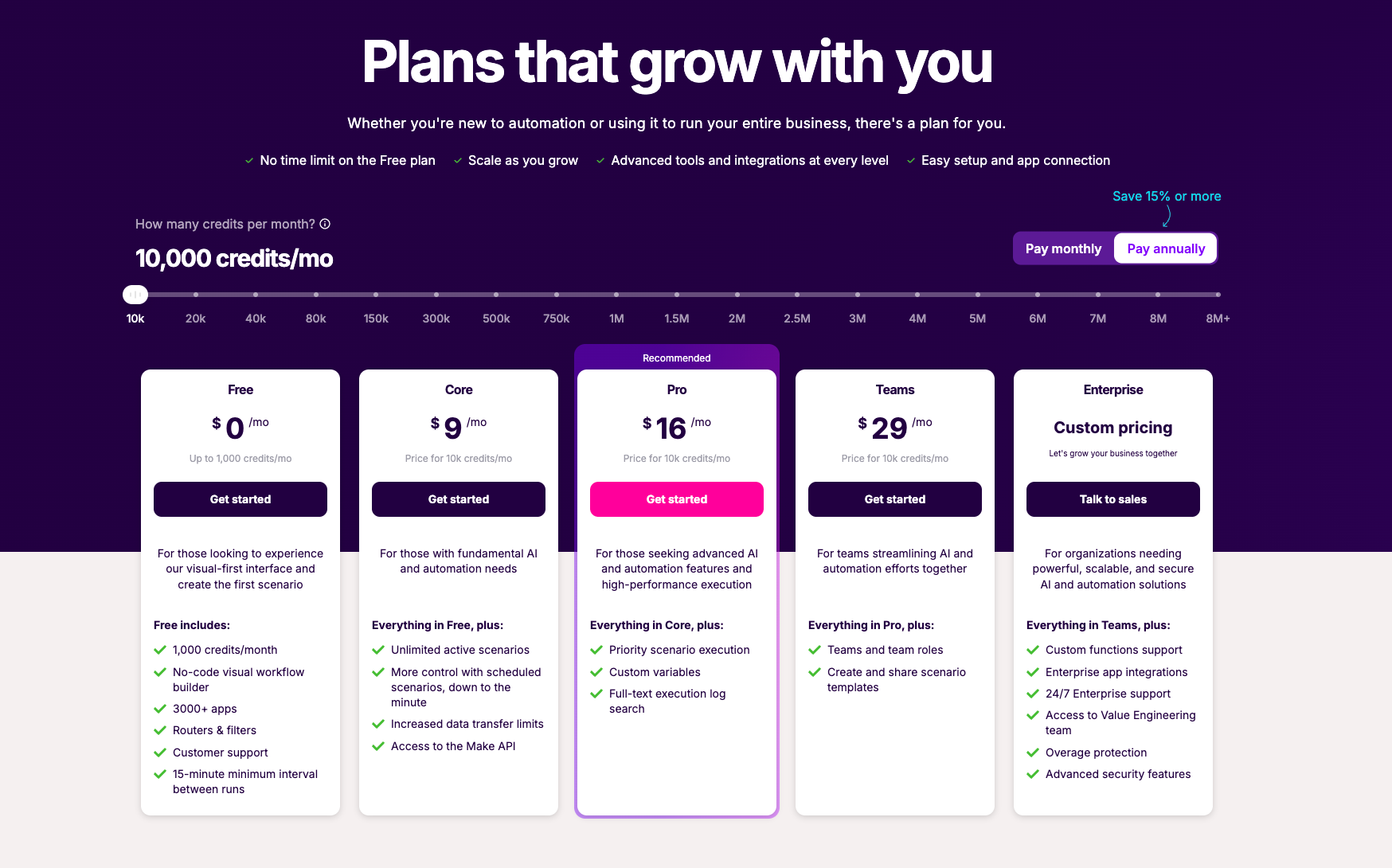
Free: $0/month – 1,000 credits/month
Core: $9/month – 10,000 credits/month
Pro: $16/month – 10,000 credits/month plus priority execution and advanced features
Teams: $29/month – 10,000 credits/month plus team collaboration
Enterprise: Custom pricing
4.
Stack AI
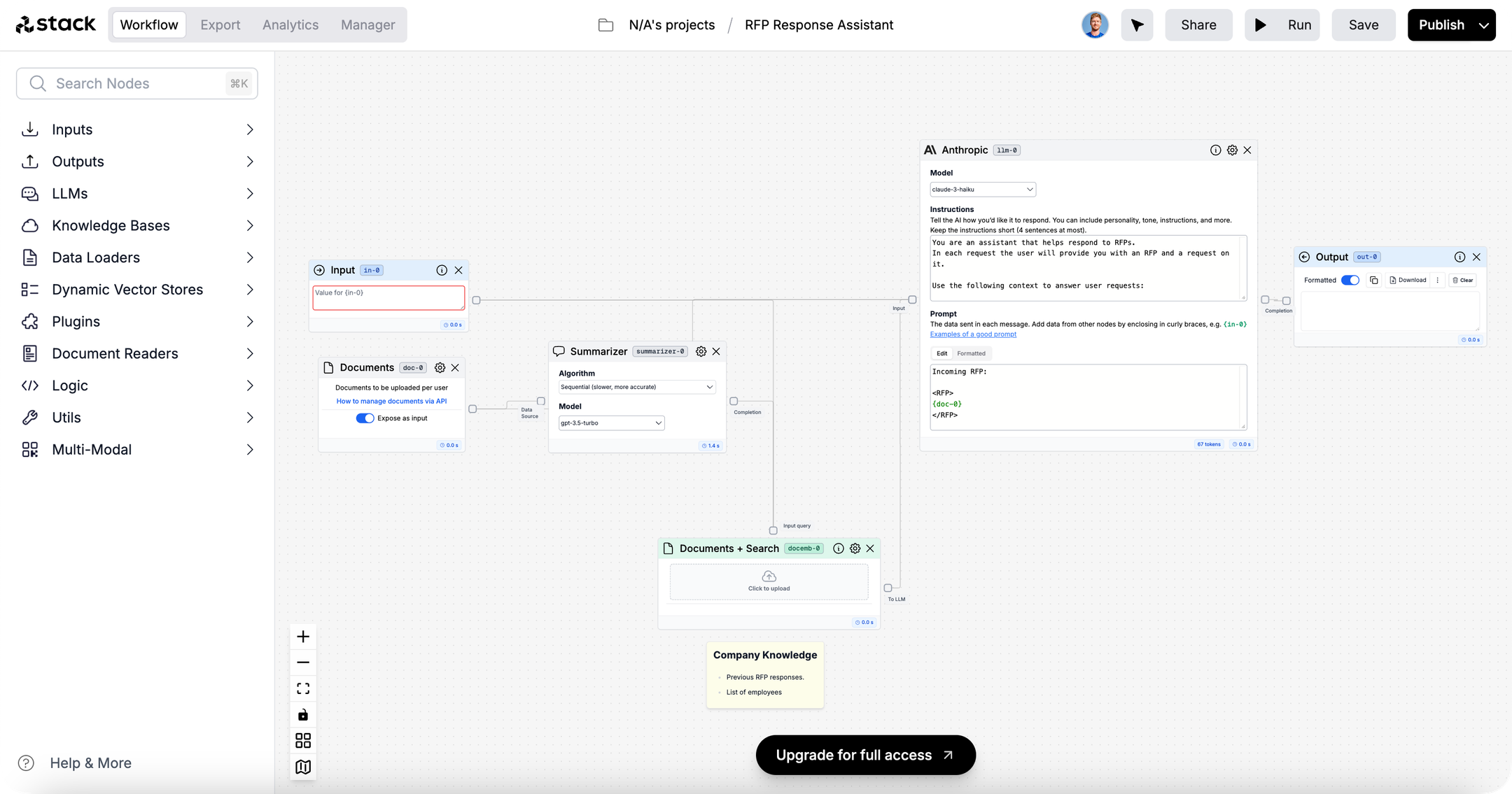
Stack AI is an enterprise-focused platform for building and deploying AI agents with a strong emphasis on security and governance. It offers a visual workflow builder for creating agentic workflows, 100+ enterprise integrations, and flexible deployment options including multi-tenant, VPC, and on-premise. The platform is certified for HIPAA, SOC 2 Type II, GDPR, and ISO 27001, making it a fit for regulated industries like healthcare, finance, insurance, and defense. Trusted by organizations like IBM, MIT, YMCA, BAE Systems, and Nubank, Stack AI positions itself as an "AI transformation platform" for IT and enterprise architecture teams. It also provides dedicated white-glove support from AI experts to help organizations scale their agent deployments.
Product details
Enterprise-grade security certifications: HIPAA, SOC 2 Type II, GDPR, and ISO 27001 — ideal for regulated industries.
Flexible deployment options: Supports multi-tenant cloud, VPC, and on-premise deployments to meet strict data residency needs.
100+ enterprise integrations: AI agents can read, write, and execute tasks within existing enterprise systems.
Dedicated white-glove support: Hands-on guidance from AI experts throughout the deployment lifecycle.
Sales-driven model: Most meaningful features require booking a demo and negotiating custom pricing.
Pricing
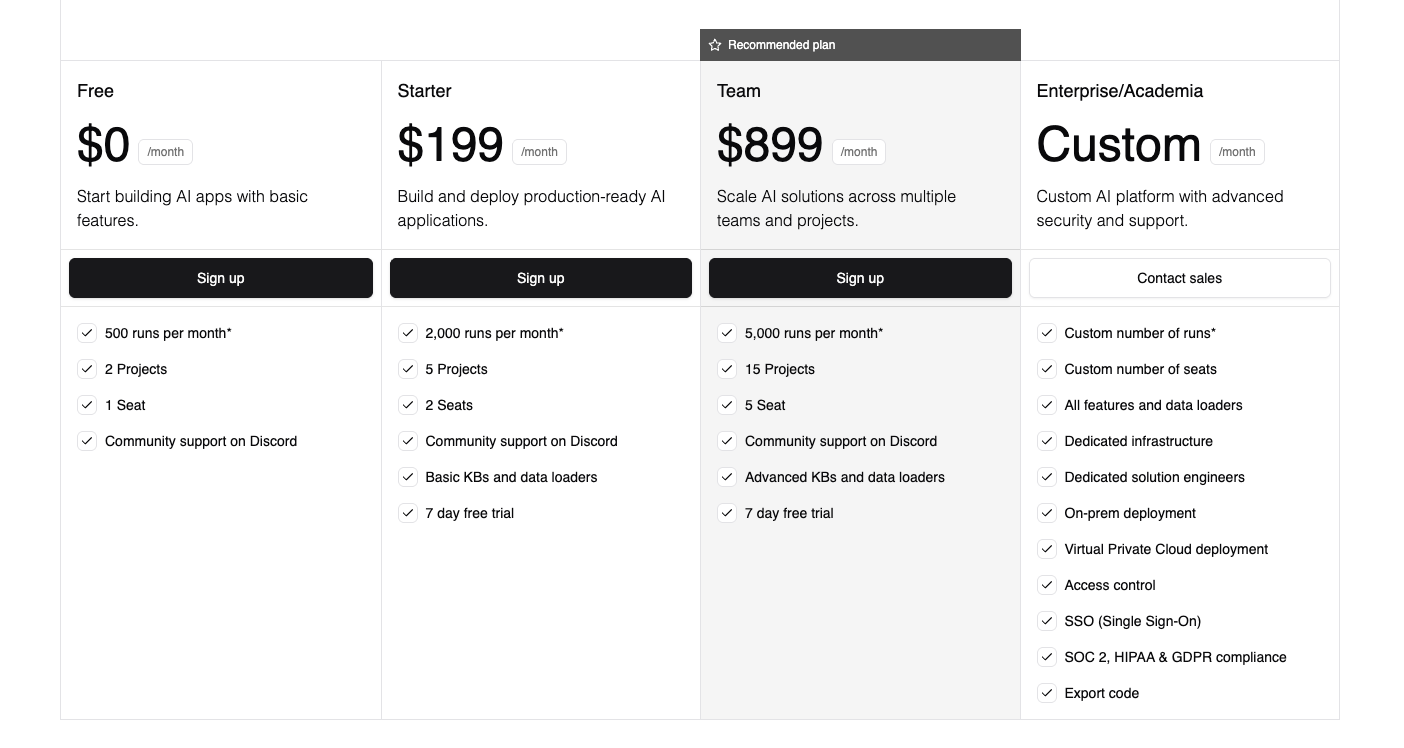
Free: $0/month — 500 runs/month, 2 projects, 1 seat, community support on Discord.
Enterprise: Custom pricing — custom runs, unlimited projects, custom seats, all features and data loaders, dedicated infrastructure, on-prem and VPC deployment, SSO, access control, SOC 2/HIPAA/GDPR compliance, dedicated solution engineers.
5.
n8n
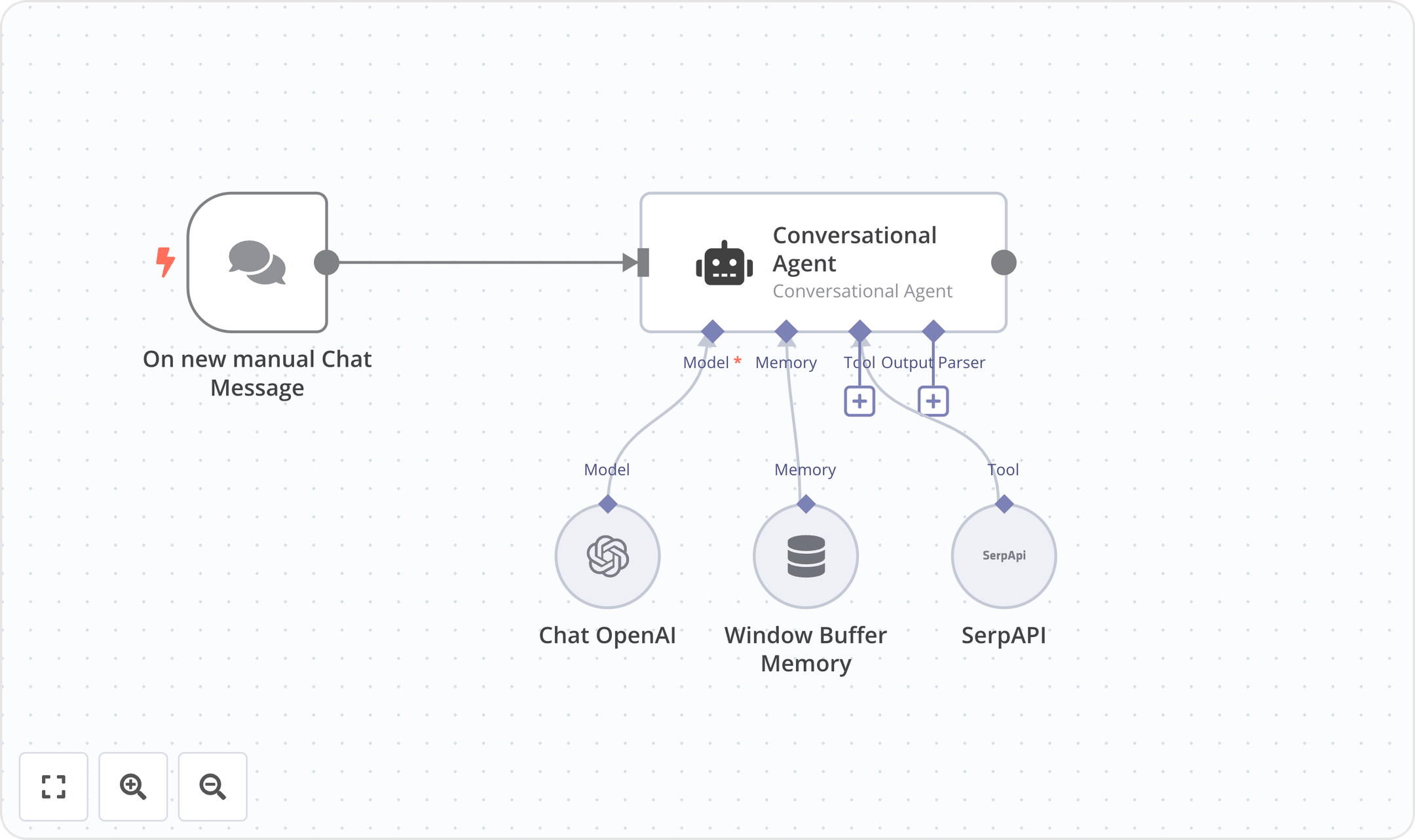
n8n is an open-source workflow automation platform built for technical teams. It combines a visual workflow editor with the ability to write custom JavaScript or Python code, giving technical users incredible flexibility in building automations. n8n has over 500 integrations, 1,700 templates, and self-hosting options, making it a popular tool for IT Ops, DevOps, SecOps, and Sales.
Product details
Code with no-code flexibility: Write JavaScript or Python alongside a visual UI editor.
Self-hosting available: Deploy with Docker and access the full source code on GitHub for total data control.
Execution-based pricing: Pay per full workflow run, not per step or task, making costs more predictable.
Large open-source community: n8n has a huge community with over 200k members who share templates and support.
Steep learning curve: Best suited for technical users. Non-technical team members will struggle with the code-oriented approach.
Pricing
Community Edition: Free. Self-hosted via GitHub, with standard features.
Starter: $20/mo (billed annually). Includes 2.5K executions, 5 concurrent executions, unlimited users, 1 shared project, 50 AI Builder credits, and forum support.
Pro: $50/mo (billed annually). Includes custom executions, 20 concurrent executions, 3 shared projects, 150 AI Builder credits, admin roles, global variables, workflow history, and 7-day insights.
Business: $800/mo (billed annually). Includes 40K executions (self-hosted), 6 shared projects, SSO/SAML/LDAP, Git version control, environments, 30-day insights, and scaling options.
Enterprise: You'll need to contact sales for pricing. Includes custom executions, 200+ concurrent, unlimited shared projects, 1,000 AI Builder credits, external secret store, log streaming, extended data retention, 365 days of insights, dedicated support with SLA, and invoice billing.
Startup Plan: n8n offers 50% off their Business tier for companies with fewer than 20 employees.

6.
Relevance AI
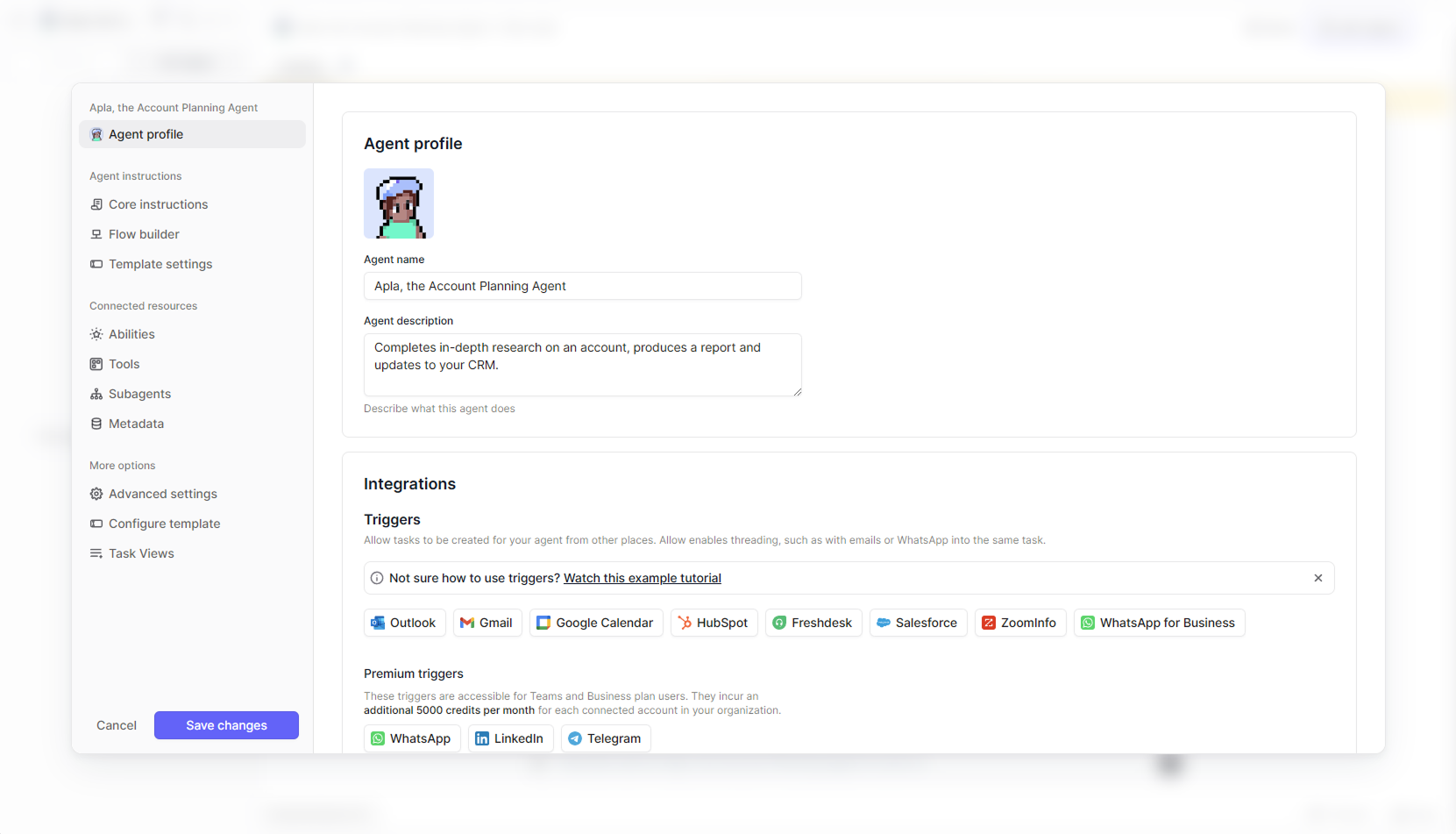
Relevance AI is an AI workforce platform built for sales and GTM teams. Its flagship AI teammate, SuperGTM, handles tasks like lead qualification, outbound prospecting, account research, and customer support — either as a copilot that assists reps or as fully autonomous workforces triggered by pipeline events. The platform includes Invent, a no-code builder that lets you create AI agents by describing tasks in plain English, plus pre-built templates (BDR Agent, Research Agent, Inbound Qualification Agent, etc.) and 2,000+ integrations including HubSpot, Salesforce, Slack, and Gmail. Relevance AI follows a progressive autonomy model — from assisted to fully self-driving — and is used by companies like Canva, Autodesk, and KPMG. Enterprise features include SOC 2 Type II compliance, SSO, RBAC, and data residency controls.
Product details
Purpose-built for GTM teams: Pre-built agent templates for BDR, research, inbound qualification, and customer support workflows.
Multi-agent workforces: Handle entire processes like inbound, outbound, and onboarding end-to-end with autonomous agent teams.
2,000+ integrations: Connects to HubSpot, Salesforce, Slack, Gmail, and many more out of the box.
Enterprise-grade security: SOC 2 Type II, GDPR, SSO, RBAC, data residency, and version control included.
Pricing
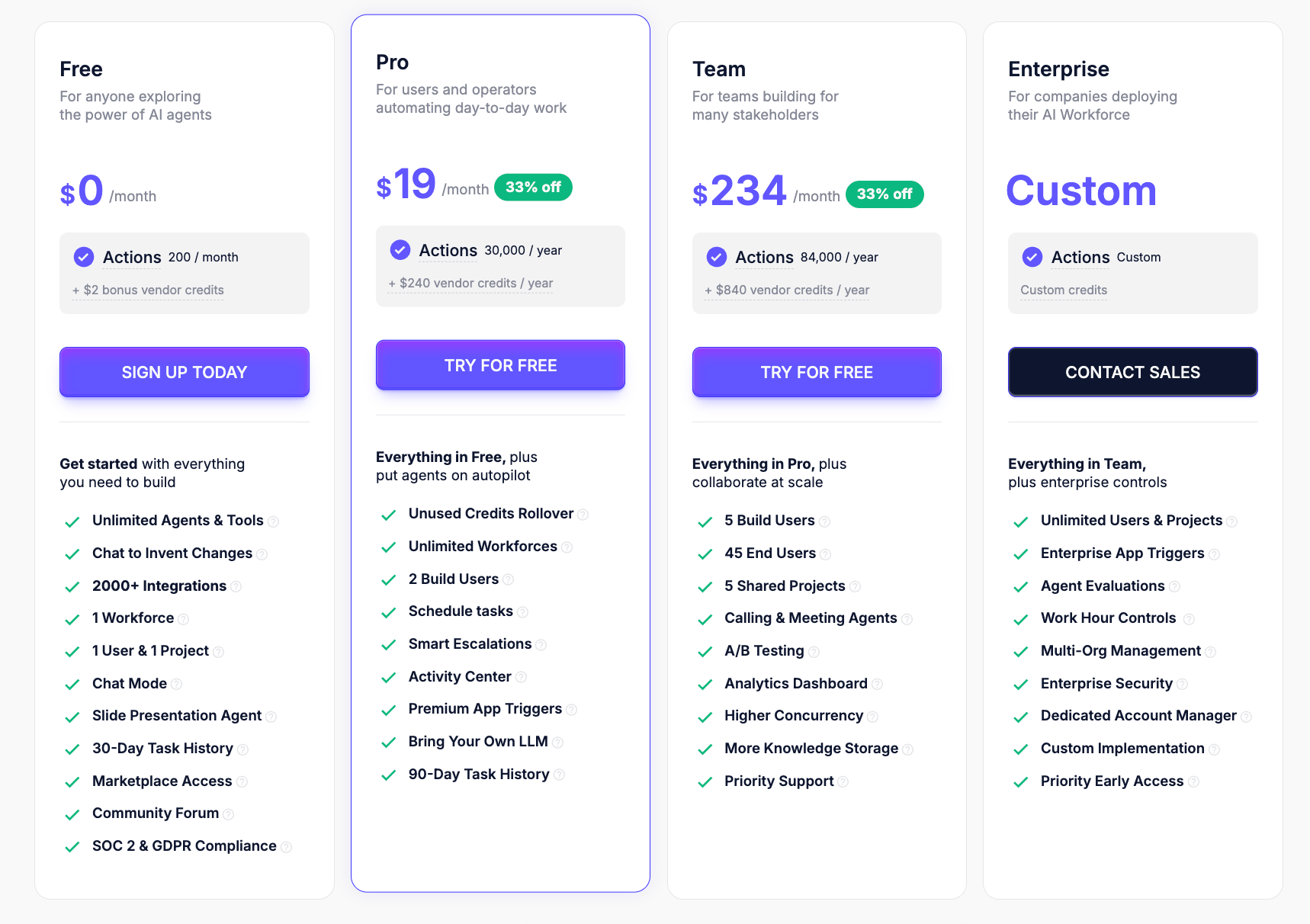
Free: $0/month – 200 actions/month, 1 user, 1 workforce, unlimited agents & tools
Pro: $19/month (billed annually) – 30,000 actions/year, 2 build users, unlimited workforces, bring your own LLM
Team: $234/month (billed annually) – 84,000 actions/year, 5 build users, 45 end users, A/B testing, calling & meeting agents
Enterprise: Custom pricing – unlimited users & projects, agent evaluations, dedicated account manager, custom implementation
7.
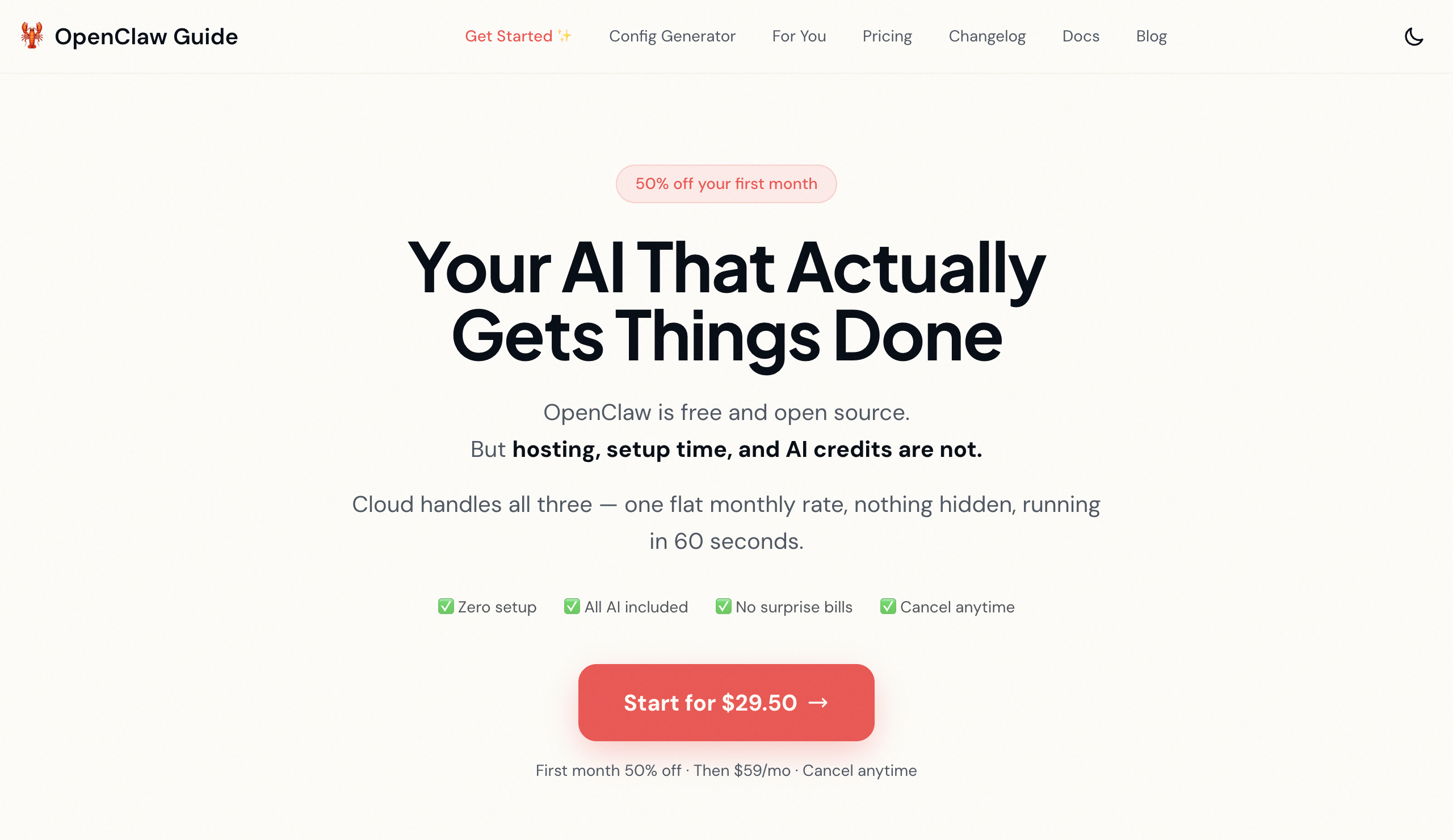
OpenClaw
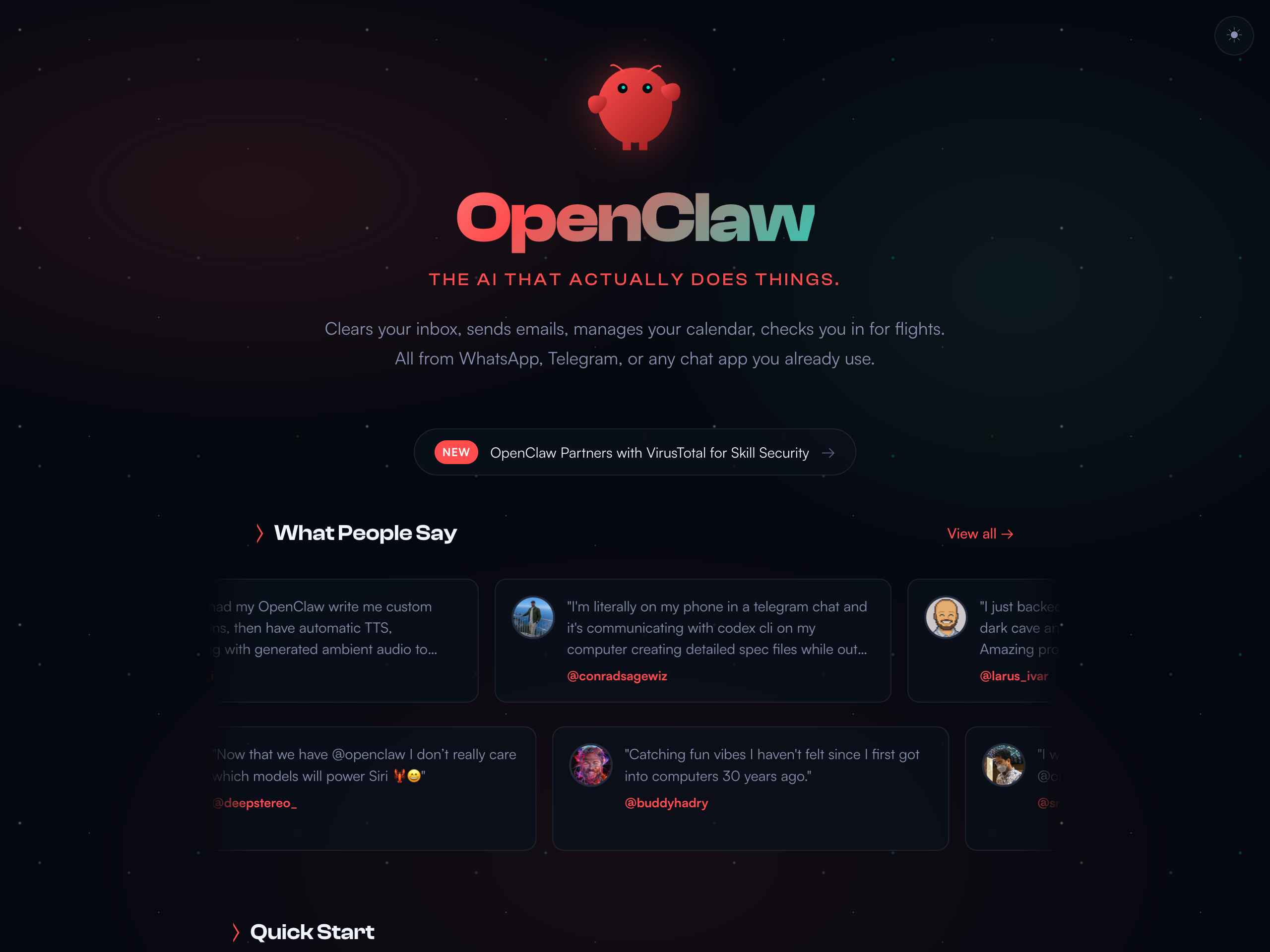
OpenClaw is an open-source personal AI assistant that runs on your own machine and connects to you through your chat apps. It features persistent memory, full system access, browser control, and an extensible skill/plugin system that lets it take real actions like sending emails, managing calendars, running shell commands, and monitoring websites. OpenClaw supports Anthropic, OpenAI, and local models, and keeps your data private by default. It has a passionate developer community and 50+ integrations, but requires either self-hosting technical know-how or a paid cloud subscription to get started.
Product details
Runs on your own machine: Your data stays private by default — supports Mac, Windows, Linux, and local AI models.
Works across chat apps: Talk to it via WhatsApp, Telegram, Discord, Slack, Signal, or iMessage.
Persistent memory and context: Remembers your preferences, past conversations, and business context across sessions.
Extensible with skills and plugins: Community-built skills plus the ability to create your own — or let OpenClaw write them itself.
Steep setup for non-technical users: Self-hosting requires comfort with CLI tools, Node.js, and server management.
Pricing
Self-Hosted (Open Source): Free — requires your own server or machine, plus LLM API keys. Own-hardware costs are mainly electricity; VPS hosting runs $5–$50/month plus $20–$200+/month in API costs.
OpenClaw Cloud: $59/month ($29.50 for the first month with 50% off) — fully managed, all API costs included (Claude, GPT-4, Gemini via smart model routing), zero setup, automatic updates, running in 60 seconds.
8.
Claude Cowork
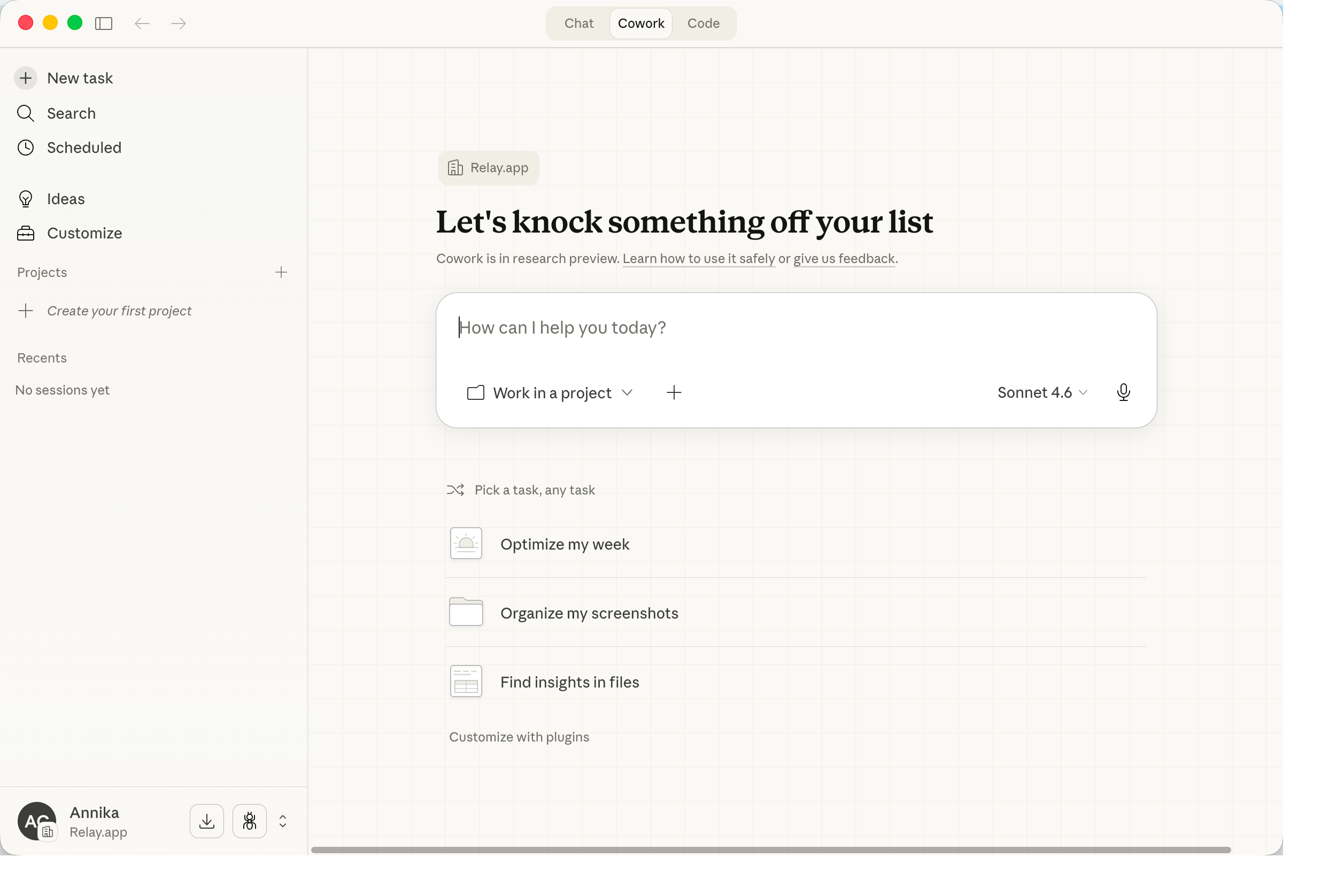
Claude Cowork is an agentic AI assistant within within Anthropic's Claude AI. It lets users delegate complex, multi-step tasks to Claude and have it execute them autonomously. Cowork can read documents, pull out key points, check your calendar, build slide decks, write summaries, and more, all from a single prompt. It integrates with tools like Google Workspace, Slack, Notion, and Linear through connectors and remote MCP, and supports custom Skills for repeatable workflows. Cowork is an impressive tool quickly growing in popularity.
Product details
Autonomous multi-step task execution: Delegate complex tasks like summarizing meetings, building decks, and writing reports.
Growing integration ecosystem: Connects to Google Workspace, Slack, Notion, Linear, and more through connectors and remote MCP.
Custom Skills: Create reusable instructions (SKILL.md) so Claude can repeat tasks consistently without re-prompting.
Cross-platform access: Available on web, desktop, iOS, and Android as part of the Claude experience.
Only works on Claude AI, of course: Since it's built into the Anthropic ecosystem, it's the only model provider you can use.
Pricing
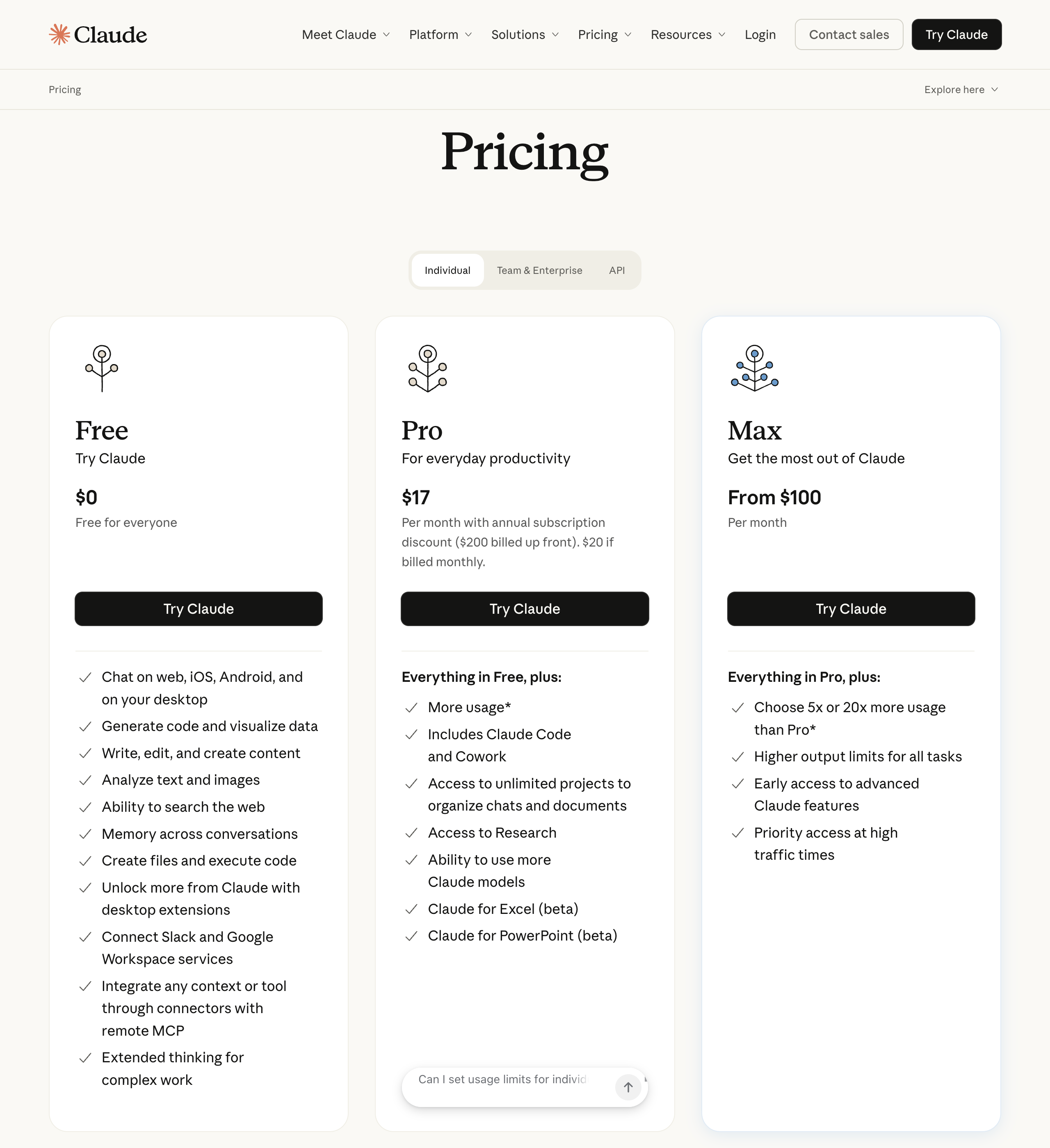
Free: $0/month – Chat, web search, code execution, desktop extensions, and connectors — but no Cowork access.
Pro: $17/month (annual) or $20/month (monthly) – Includes Cowork, Claude Code, unlimited projects, Research, memory, and more models.
Max: From $100/month – Everything in Pro, plus 5x or 20x more usage, higher output limits, and priority access.
Team: $20/seat/month (annual) or $25/seat/month (monthly) – Standard seats with Cowork, SSO, enterprise search, and admin controls. Premium seats at $100–$125/seat/month.
Enterprise: $20/seat + usage-based at API rates – All Team features plus SCIM, audit logs, HIPAA-ready offering, and custom data retention.
9.
Manus
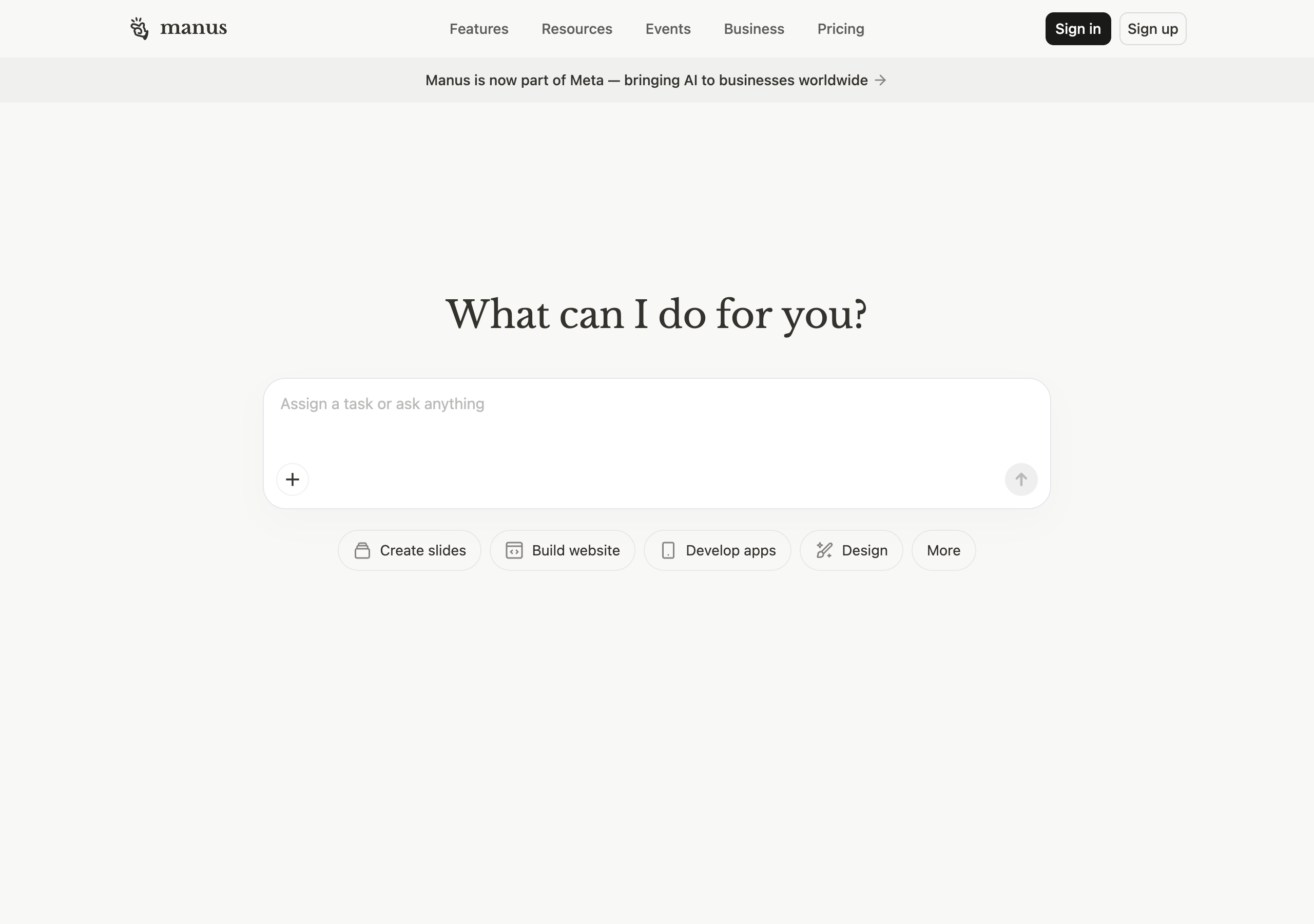
Manus is a general-purpose AI agent, now part of Meta, that can handle complex, multi-step tasks end-to-end. You describe what you need (say, build a website, create a slide deck, conduct deep research, design assets, or develop an app) and Manus executes autonomously by browsing the web, writing code, and producing deliverables. It offers features like a browser operator, Wide Research for scaling tasks across multiple sources, and integrations with Slack and email. It's powerful for one-off creative and research tasks.
Product details
General-purpose agent: Great for executing one-off tasks, both simple and complex multi-step.
Handles a wide range of tasks end-to-end: From building websites to creating slides, designing assets, and conducting in-depth research.
Browser operator feature: Lets the AI navigate and interact with the web on your behalf.
Wide Research capability: Scales tasks across multiple sources simultaneously.
Available on mobile, desktop, web, and via API: Flexible access across all platforms.
Pricing
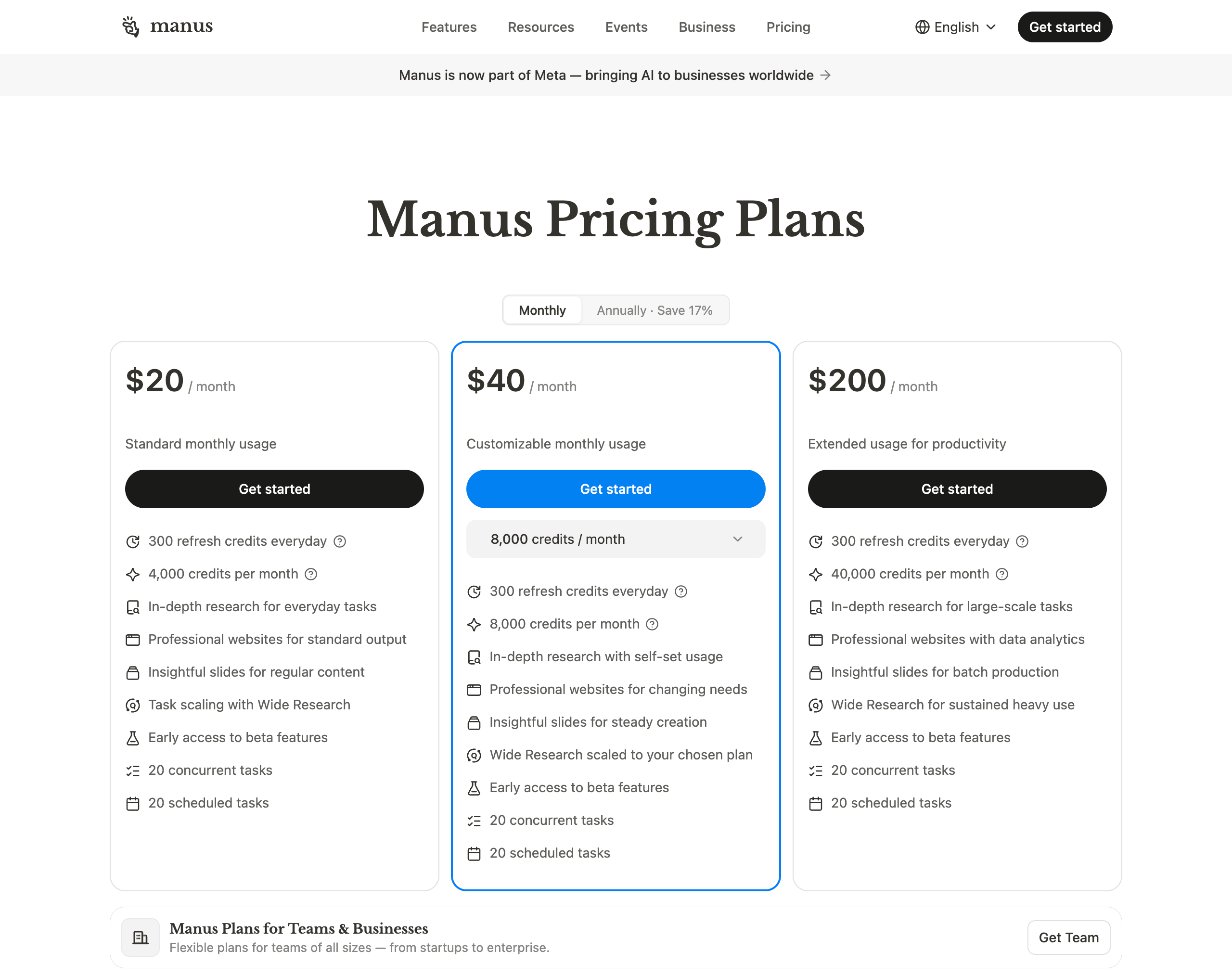
Standard: 4,000 credits/month + 300 daily refresh credits, 20 concurrent tasks, 20 scheduled tasks.
Plus: 8,000 credits/month + 300 daily refresh credits, 20 concurrent tasks, 20 scheduled tasks (customizable usage).
Pro: 40,000 credits/month + 300 daily refresh credits, 20 concurrent tasks, 20 scheduled tasks (extended usage).
Team/Enterprise: Flexible plans for teams of all sizes with SSO and API access.
No free tier listed — all plans appear to be paid. Annual billing saves 17%. Exact per-month pricing is displayed dynamically on their site.
10.
Tray

Tray.ai is an AI orchestration platform that combines a traditional iPaaS with AI agent building capabilities. Its Merlin Agent Builder lets teams create agents that can reason, act, and learn across connected systems — deployable to Slack, web apps, or APIs. The platform offers 600+ connectors, pre-built agent accelerators for IT, HR, knowledge, and support use cases, and enterprise-grade governance features like audit trails, guardrails, and role-based access control. Tray positions itself as a low-code builder for business technologists and development teams, with a focus on scaling AI agents across the enterprise stack. Pricing is entirely custom and sales-driven, with no self-serve plans available.
Product details
About Tray:
Enterprise-grade governance: Includes guardrails, audit trails, RBAC, and Merlin Guardian for sensitive data protection.
Pre-built agent accelerators: Ready-to-use agents for ITSM, HR, knowledge, and support speed up time-to-value.
600+ connectors: Broad integration library for connecting across complex enterprise stacks.
Flexible LLM support: Choose the best model for each use case with no vendor lock-in.
Enterprise-oriented: Designed for large IT teams.
Pricing
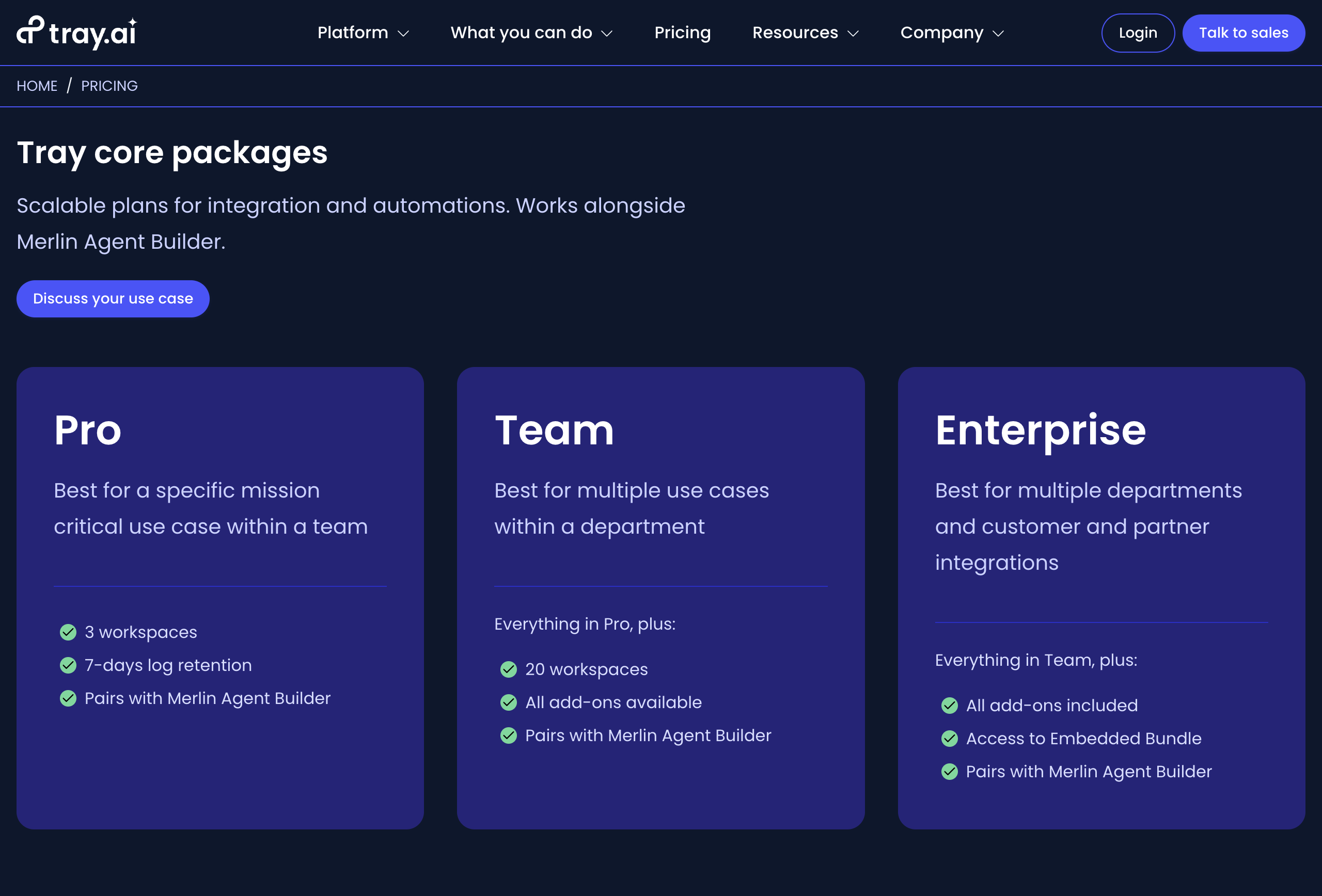
Pro: Custom pricing – 3 workspaces, 7-day log retention, pairs with Merlin Agent Builder
Team: Custom pricing – 20 workspaces, all add-ons available, pairs with Merlin Agent Builder
Enterprise: Custom pricing – unlimited workspaces, all add-ons included, Embedded Bundle access
Merlin Agent Builder: Purchased separately – includes pre-built accelerators, guardrails, multi-LLM support
ITSM Accelerator Starter: Pre-built ITSM agent with 50,000 tasks, Slack/Teams integration, guided onboarding, and enterprise support
No free tier — all plans require contacting sales.
The bottom line
The AI automation landscape in 2026 looks very different from even a year ago. Agentic workflows, multi-agent systems, and built-in governance have moved from buzzwords to baseline expectations. When picking a Gumloop alternative, focus on what matters most for your specific situation — ease of use, AI agent capabilities, human-in-the-loop oversight, integrations, security, and pricing that makes sense for your workflow volume.
Here's a quick recap of the 10 alternatives we covered:
Relay.app — Best all-around alternative. Easiest to use, with built-in human-in-the-loop controls and AI agent building in plain language.
Zapier — Best for integration breadth. 8,000+ app connectors with a mature, expanding AI toolkit including dedicated AI Agents and Chatbots.
Make — Best for visual power users. Canvas-based editor with advanced logic, branching, and 3,000+ integrations.
Stack AI — Best for regulated enterprises. HIPAA, SOC 2, ISO 27001, and on-prem deployment for healthcare, finance, and defense.
n8n — Best for technical teams. Open-source, self-hostable, with code + no-code flexibility and execution-based pricing.
Relevance AI — Best for sales and GTM. Purpose-built AI agents for prospecting, lead qualification, and pipeline management with multi-agent workforces.
OpenClaw — Best for privacy-first power users. Open-source, runs locally on your machine, and works across WhatsApp, Telegram, Slack, Signal, and more.
Claude Cowork — Best for individual productivity. Autonomous multi-step task execution powered by Anthropic's Claude with growing integrations via MCP.
Manus — Best for complex one-off tasks. Now part of Meta — a general-purpose AI agent for deep research, web browsing, and content creation.
Tray — Best for enterprise IT orchestration. 600+ connectors, Merlin Agent Builder, governance features, and pre-built agent accelerators.
Don't be afraid to test a few tools before committing — most platforms on this list offer free tiers or trials that let you kick the tires on real workflows.
If you want my recommendation for where to start, Relay.app is the clear winner. It combines ease of use, powerful AI agent capabilities, and built-in human-in-the-loop controls that none of the other tools match. You can describe what you want in plain language, and Relay.app builds the agentic workflow for you — no steep learning curve, no credit-counting anxiety, and no giving up control over what your AI agents do. It's ideal for both beginners who want to get started in minutes and experienced users who need reliable, production-ready automations.
Ready to start scaling your business with Relay.app? Sign up for free today.
Jacob Bank
Founder/CEO at Relay.app

Jacob is the Founder and CEO of Relay.app. Prior to founding Relay.app, Jacob was a Director of Product Management at Google, where he led the product teams for Gmail, Google Calendar, and several other Google Workspace products. Before that, Jacob was the Co-founder and CEO of Timeful (acquired by Google in 2015), a smart calendar that leveraged insights from behavioral psychology and AI to help people spend time on their most important priorities. He has a BA in Computer Science from Cornell University and was pursuing a PhD in the AI Lab at Stanford before dropping out to found Timeful.
FAQs
Which Relay.app plan should I start with?
Which workflow tool should I use if I'm not really technical?
What's the best AI automation tool for small businesses and entrepreneurs?
What does human-in-the-loop mean?
Which automation platforms don't require coding to use?
Can I replace Gumloop or Relevance AI with Relay.app for AI workflows?
How does Relay.app keep AI token costs low compared to general-purpose AI agent builders?
How does using smaller AI models for simple tasks in a workflow help reduce token costs?
